Both FluxCD and ArgoCD are CNCF-graduated GitOps tools for Kubernetes. Both watch a Git repository and reconcile your cluster to match it. Both are mature, well-supported, and running production workloads at serious scale. So the interesting question isn’t “which is better” it’s “what are the actual differences, and which one fits how my team works?”
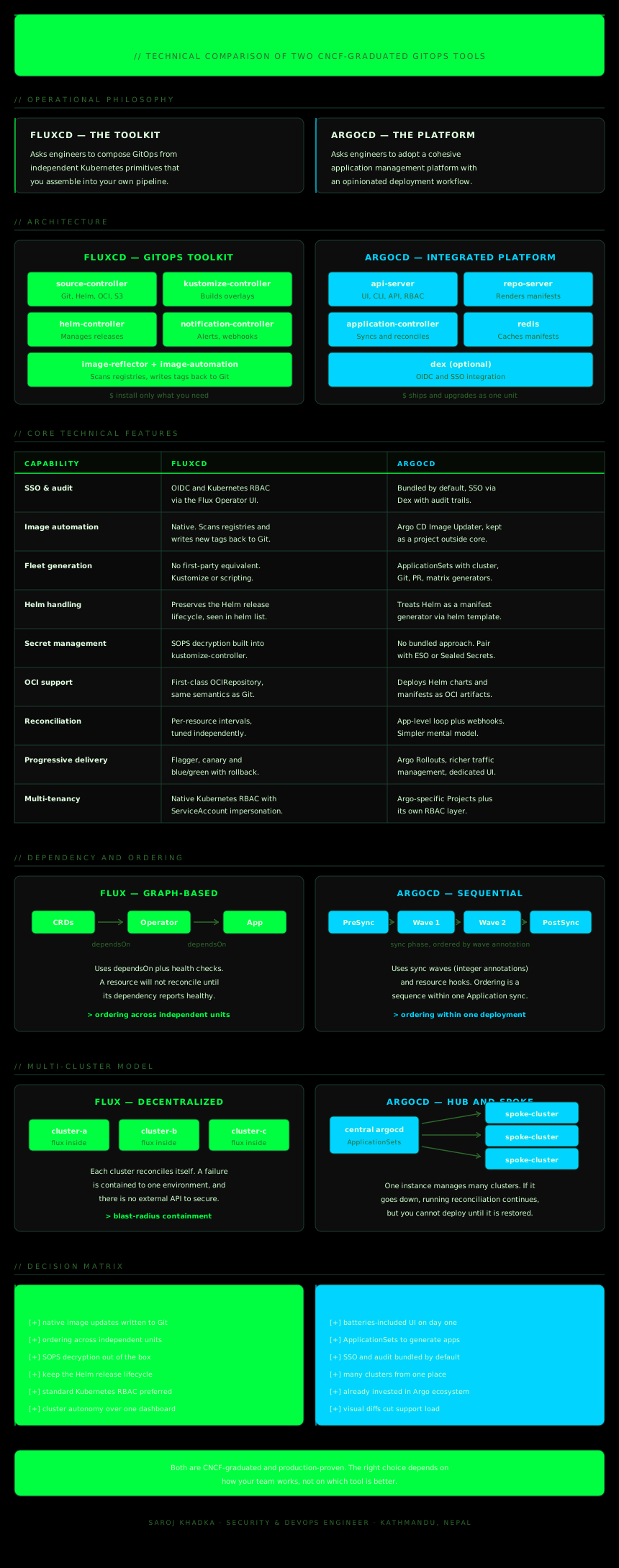
The short version, if you only read one thing. The rest of this post unpacks each row.
Operational Philosophy
Before any feature comparison, there’s a single distinction that explains almost everything downstream:
Flux asks platform engineers to compose GitOps from Kubernetes primitives. ArgoCD asks platform engineers to adopt an application management platform.
Flux gives you a set of controllers and CRDs that you assemble into a pipeline. ArgoCD gives you a product with an opinion about what a deployment is. Neither is wrong. But if you find yourself repeatedly fighting one of them, it’s usually because you wanted the other philosophy.
Architecture
FluxCD: The Toolkit Model
Flux v2 is built on the GitOps Toolkit — a collection of independent controllers, each doing one job:
| Controller | Responsibility |
|---|---|
source-controller |
Fetches from Git, Helm repos, OCI registries, S3 buckets |
kustomize-controller |
Builds and applies Kustomize overlays |
helm-controller |
Manages Helm releases |
notification-controller |
Sends alerts, receives webhooks |
image-reflector-controller |
Scans container registries for new tags |
image-automation-controller |
Writes updated image tags back to Git |
You install only what you need. Each controller exposes its own CRDs (GitRepository, OCIRepository, Kustomization, HelmRelease, ImagePolicy), and they compose together.
ArgoCD: The Platform Model
ArgoCD ships as a cohesive application with a few core components:
| Component | Responsibility |
|---|---|
api-server |
Serves the UI, CLI, and API; handles auth and RBAC |
repo-server |
Clones repos and renders manifests |
application-controller |
Compares desired vs live state and syncs |
redis |
Caches rendered manifests and state |
dex (optional) |
OIDC/SSO integration |
The central abstraction is the Application CRD: one Application = one source repo path + one destination cluster/namespace.
The Differences That Matter
1. User Interface
FluxCD takes an unbundled approach: the Flux project ships the flux CLI, and the GUI layer is a separate ecosystem of open-source projects you choose from. That ecosystem is larger than most comparisons admit:
| Project | What it is |
|---|---|
controlplaneio-fluxcd/flux-operator |
Web UI embedded in the Flux Operator, with OIDC SSO and Kubernetes RBAC for multi-tenant clusters |
gimlet-io/capacitor |
General-purpose Flux UI aimed at debugging Flux and application issues |
skyhook-io/radar |
Kubernetes UI with a Flux workspace: topology, managed-resource views, failure diagnosis, reconcile/suspend/resume |
dgunzy/flux9s |
K9s-inspired terminal UI — real-time monitoring, dependency graphs, reconciliation history |
headlamp/flux-plugin |
Flux plugin for Headlamp, the extensible Kubernetes UI |
backstage-community/plugin-flux |
Flux views inside Backstage, with source syncing and suspend/resume |
freelensapp/freelens-fluxcd-extension |
Flux extension for Freelens, a desktop Kubernetes client |
weaveworks/vscode-gitops-tools |
GitOps management from inside VS Code |
weaveworks/weave-gitops |
Weaveworks’ open-source Flux GUI, installable via a HelmRelease |
Practically, “Flux has no UI” is outdated. If you want a web dashboard with SSO and multi-tenant RBAC, the Flux Operator provides one option that covers those capabilities. If you live in a terminal, flux9s. If your org already runs Backstage or Headlamp, there’s a plugin.
ArgoCD has a genuinely excellent web UI: a live resource tree, real-time sync status, colour-coded health, inline diffs between Git and cluster, pod logs, one-click sync and rollback.
Verdict: ArgoCD has the edge on cohesion — one UI, maintained by the same project, that every ArgoCD user shares. Flux gives you more choice but pushes evaluation and operational burden onto you.
2. Reconciliation Direction
FluxCD’s reconciliation model is entirely pull-based. Everything lives inside the cluster; there is no external API to expose, which reduces attack surface. The only outbound mutation is optional image automation, which writes updated image references back to Git — never directly to the cluster. Git remains the source of truth throughout.
ArgoCD is also pull-based for reconciliation, but its API server is a control plane you interact with from outside. That’s what makes the UI possible and it’s also a component you need to secure, expose, and authenticate against.
A nuance worth stating precisely: Flux has no centralized API or UI control plane. It absolutely has controllers, and those controllers are a control plane in the Kubernetes sense — they just run entirely inside the managed cluster.
3. Reconciliation Behaviour
An underrated operational difference.
Flux gives every resource its own reconciliation interval. A GitRepository might poll every minute, a Kustomization reconcile every ten, a HelmRelease every hour. Each is tuned independently, and dependsOn establishes ordering between them.
ArgoCD runs an application-level reconciliation loop with a global default interval, refreshed on webhook events, and governed by per-Application sync policies (manual, automated, self-heal, prune).
The practical upshot: Flux gives finer-grained control over how often each piece of your pipeline checks itself. ArgoCD gives a simpler mental model with webhook-driven responsiveness.
4. Dependency Management and Ordering
This is one of the biggest practical differences when deploying infrastructure, and it’s where teams most often hit a wall.
Flux uses dependsOn on Kustomization and HelmRelease resources, combined with health checks. A Kustomization won’t reconcile until its dependencies report healthy. Ordering is expressed as a graph.
ArgoCD uses sync waves (integer annotations that order resources within a sync), resource hooks (PreSync, Sync, PostSync, SyncFail), and sync phases. Ordering is expressed as a sequence within a single Application.
Flux’s model is better suited to ordering across independent units — install the CRDs, wait for them to be healthy, then install the operator that needs them. ArgoCD’s is better suited to ordering within a deployment — run a migration job before the new pods roll.
5. ApplicationSets — ArgoCD’s Strongest Feature
ArgoCD’s ApplicationSet deserves more attention than most comparisons give it. It generates Applications from a template using generators:
- Cluster generator — one Application per registered cluster
- Git directory generator — one Application per directory in a repo
- Git file generator — Applications driven by config files
- Pull request generator — an ephemeral Application per open PR
- Matrix and merge generators — combine the above combinatorially
If you’re running “the same app across thirty clusters” or “preview environments per PR,” this is a genuinely large productivity difference.
Flux has no first-party equivalent abstraction. Teams typically achieve similar outcomes with Kustomize overlays, Flux’s own Git generators, Terraform, Cluster API, or scripting all workable, none as turnkey.
Verdict: clear win for ArgoCD.
6. Image Automation
FluxCD can scan a container registry, detect a new image tag matching a policy (semver range, regex, timestamp ordering), commit the updated tag back to Git, and then deploy it.
ArgoCD handles this through Argo CD Image Updater, maintained as a separate project rather than part of the core platform. It’s production-used and actively developed; the distinction is packaging and integration, not capability.
Verdict: Flux wins on integration — it’s one less moving part, and the write-back-to-Git flow is native.
7. OCI Artifacts
OCI registries have become a major part of GitOps, and both tools support them.
Flux treats OCI as a first-class source via the OCIRepository CRD, sitting alongside GitRepository in the same reconciliation model. You can push manifests as OCI artifacts from CI and have Flux consume them directly.
ArgoCD can deploy Helm charts and manifests stored as OCI artifacts, with OCI-based Helm repositories supported as an Application source.
Both work. Flux’s is slightly more unified in that OCI is just another source type with identical semantics; ArgoCD’s is more oriented around OCI-hosted Helm charts.
8. Secret Management
A production concern that’s easy to overlook when evaluating.
Flux has first-class SOPS integration built into kustomize-controller — encrypted secrets in Git are decrypted during reconciliation with no additional component.
ArgoCD doesn’t bundle a single approach. Teams commonly pair it with External Secrets Operator, Sealed Secrets, the argocd-vault-plugin, or SOPS via a Config Management Plugin.
Both end up in a good place, but Flux gives you a working answer out of the box where ArgoCD asks you to choose one.
9. Helm Handling
FluxCD’s helm-controller performs real Helm installs and upgrades. Releases appear in helm list, hooks execute, and rollback behaves the way Helm users expect.
ArgoCD by default runs helm template and applies the rendered YAML. Release state isn’t stored in Helm secrets, and Helm hooks are translated into Argo’s own hook mechanism.
This is a deliberate design choice rather than a limitation. Treating Helm as a pure renderer means upgrades become fully declarative, there’s no separate release state to drift, and everything visible in the cluster traces back to rendered manifests in Git. Plenty of teams prefer it.
Verdict: Flux preserves Helm’s release lifecycle. ArgoCD treats Helm primarily as a manifest generator. Which is “better” depends entirely on whether your team wants that lifecycle.
10. Multi-Tenancy
FluxCD does multi-tenancy the Kubernetes-native way: namespaces, ServiceAccounts, and RBAC. A Kustomization can impersonate a specific ServiceAccount, so tenant permissions are enforced by the Kubernetes API server itself.
ArgoCD uses Projects — an ArgoCD-specific abstraction restricting which repos, clusters, and namespaces a set of Applications can touch — combined with its own RBAC layer and SSO integration.
Verdict: Flux is simpler and more Kubernetes-idiomatic. ArgoCD is more capable if you need per-user access control with SSO.
11. Multi-Cluster Management
ArgoCD was designed for it. One instance manages many clusters from a single pane of glass, with ApplicationSets generating Applications across them. The hub-and-spoke model is well-trodden.
FluxCD takes the opposite view: install Flux in each cluster and let each reconcile itself. No single control plane to fail. Aggregated views across clusters are available through ecosystem tools like Radar and the Flux Operator UI, though these still require access to each cluster rather than reading from a central store.
The trade-off worth naming: if the central ArgoCD instance goes down, reconciliation already running on spoke clusters continues, but you can’t manage or deploy to any of them until it’s restored. With Flux, a failure is contained to one cluster.
Verdict: ArgoCD for centralised visibility and control; Flux for blast-radius containment.
12. Notifications
Both have mature systems, and both deserve mention since you’ll configure one on day two.
Flux ships the notification-controller, which handles both outbound alerts (Slack, Teams, Discord, generic webhooks, Prometheus Alertmanager) and inbound webhook receivers that trigger immediate reconciliation.
ArgoCD has Argo CD Notifications, with a trigger-and-template model covering similar destinations, plus sync status subscriptions per Application.
Roughly at parity. Flux’s inbound receiver support is a slight edge if you want Git pushes to trigger instant reconciliation rather than waiting for the next interval.
13. Progressive Delivery
FluxCD integrates with Flagger for canary releases, blue/green deployments, A/B testing, and automated rollback based on metrics.
ArgoCD integrates with Argo Rollouts for the same category of thing.
Both are separate installs. Argo Rollouts has richer traffic-management integrations and a better UI story; Flagger is often described as simpler to configure. Close to a tie.
14. Extensibility
A philosophical difference more than a feature one.
Flux expects you to extend it with Kubernetes. Its CRDs compose, and if you need something new you write a controller or a Kustomize plugin. Platform engineers comfortable with the operator pattern find this natural.
ArgoCD extends through Config Management Plugins — you register a custom manifest generator (jsonnet, cdk8s, a homegrown templating system) and Applications can use it as a source type. Extension happens inside the Application abstraction rather than alongside it.
15. Configuration Style and Drift
FluxCD is entirely declarative. Every piece of config is a CRD in Git. flux bootstrap even commits Flux’s own installation manifests to your repo, so Flux manages itself via GitOps.
ArgoCD supports declarative config (Applications as YAML, app-of-apps, ApplicationSets), but also lets you create and modify Applications through the UI and CLI.
Be precise about what drifts here. ArgoCD continuously reconciles managed resources, so your deployed Kubernetes objects don’t silently diverge. The risk is that UI and CLI operations can introduce Application configuration that isn’t represented in Git — drift in ArgoCD’s own config, not in the workloads it manages. Teams that enforce declarative Application management avoid this entirely.
16. Bootstrap Experience
Flux has the stronger initial setup story. A single command:
flux bootstrap github --owner=myorg --repository=fleet --path=clusters/prod
installs the controllers, commits Flux’s own manifests to your repo, creates the GitRepository and Kustomization pointing at that path, and configures deploy keys. Flux is now managing itself via GitOps from the first minute.
ArgoCD installs via manifests or Helm, then you create Applications — through the UI, CLI, or declaratively. There’s no equivalent single command that wires the whole loop, though app-of-apps patterns get you to a similar place with more steps.
17. Resource Footprint
Flux is generally lighter — a set of controllers with no API server and no Redis dependency.
ArgoCD carries more baseline weight, primarily the api-server and Redis.
Worth qualifying: actual consumption depends far more on the number of Applications, clusters, repositories, and reconciliation frequency than on the baseline install. Don’t expect dramatic differences at small scale, and benchmark rather than assume at large scale.
18. Ecosystem Fit
Many teams choose on ecosystem alignment rather than feature-by-feature comparison.
Argo ecosystem: Argo CD, Argo Rollouts, Argo Workflows, Argo Events. If you’re already running Workflows for CI or Events for triggering, Argo CD fits naturally alongside them.
Flux ecosystem: the GitOps Toolkit controllers, Flagger, the Flux Operator. Tighter in scope, more focused on the GitOps problem specifically.
Side-by-Side
| FluxCD | ArgoCD | |
|---|---|---|
| Philosophy | Compose from Kubernetes primitives | Adopt an application platform |
| Architecture | Composable controllers | Integrated platform |
| Web UI | Ecosystem of options | Single first-class, built in |
| Core abstraction | Kustomization, HelmRelease |
Application |
| Reconciliation | Per-resource intervals | App-level loop plus webhooks |
| Ordering | dependsOn plus health checks |
Sync waves, hooks, phases |
| Fleet generation | No first-party equivalent | ApplicationSets with generators |
| Image automation | Built in, writes to Git | Separate Image Updater project |
| OCI support | First-class OCIRepository |
OCI Helm charts and manifests |
| Secrets | SOPS built in | Choose your own integration |
| Helm | Native Helm releases | Helm as manifest generator |
| Multi-tenancy | Kubernetes RBAC plus impersonation | Projects plus own RBAC |
| Multi-cluster | Flux per cluster | Hub and spoke, one instance |
| Notifications | notification-controller | Argo CD Notifications |
| Extensibility | Write controllers | Config Management Plugins |
| Bootstrap | Single flux bootstrap command |
Install, then create Applications |
| Config drift | Very hard to introduce | Possible in Application config |
How to Choose
Pick ArgoCD if:
- You want one batteries-included UI with no separate evaluation to run
- You need ApplicationSets to generate Applications across many clusters or PRs
- You want SSO, fine-grained RBAC, and audit trails bundled by default
- Centralised management of many clusters matters more than blast-radius containment
- You’re already invested in the Argo ecosystem (Workflows, Events, Rollouts)
- Visual diffs and one-click rollback would meaningfully reduce support load
Pick FluxCD if:
- You want automated image updates committed back to Git as a native capability
- Dependency ordering across independent units is central to your platform
- You want SOPS secret decryption working out of the box
- You need Helm to preserve its release lifecycle
- You prefer standard Kubernetes RBAC over a tool-specific permission model
- Cluster autonomy and minimal attack surface matter to you
- You’d rather pick a UI that fits your existing platform than adopt a bundled one
Consider both: Some organisations run Flux for platform and infrastructure components — where automation, ordering, and self-management matter — and ArgoCD for application teams, where visibility and self-service matter. It’s more to operate, but it’s a legitimate pattern.
Closing Thought
There is no wrong answer here. Both projects are CNCF-graduated, actively maintained, and running production workloads at large scale. The failure mode isn’t picking the “wrong” tool it’s picking a tool that doesn’t match how your team actually works, and then fighting it.
If you want a single opinionated platform with everything in the box, ArgoCD. If you want composable controllers and the freedom to assemble your own stack, Flux. Try both on a non-critical cluster for a week before committing; the difference in feel becomes obvious fast.